

Dual occupancy has quietly become one of the fastest-growing build categories in Australia. Across Sydney, Brisbane, Melbourne and the regional centres pushing back against city prices, more builders are looking at a single block and seeing two homes where there used to be one. Demand from investors is climbing, multi-generational households are reshaping what families want from a property, and policy is firmly pointed at increasing supply through new construction.
For builders, this shift is opening up genuine opportunities. The question is no longer whether to add dual occupancy to your offering. It is how to design and deliver projects that stand out in a market that is starting to get crowded.
At Plungie, we work with builders across Australia delivering precast plunge pools into duplex and dual occupancy projects, and we are seeing the shift play out in real time. The rest of this article walks through what is driving the boom, what buyers want from the new generation of duplex homes, and how a well-chosen pool decision can lift a project from competent to standout.
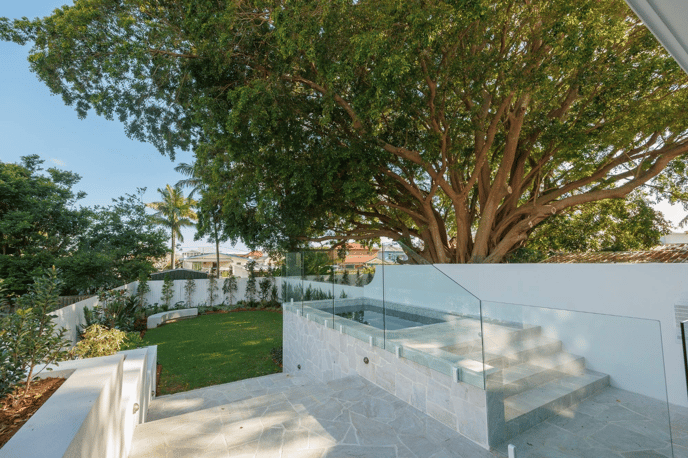
What's Driving the Dual Occupancy Boom
Three forces are doing most of the work here.
1. Land
In established suburbs across the eastern seaboard, well-located blocks are scarce and expensive. Building two dwellings on a single lot makes the numbers work in a way that one home no longer can, for both developers chasing yield and homeowners trying to unlock equity from the land they already own.
2. Housing Supply
Australia is in the middle of a chronic shortage, and federal and state policy has shifted decisively towards rewarding new builds. That is showing up in planning reform across the country. NSW has broadened complying development pathways for duplexes, terraces and townhouses, with reforms now in force since the 2024-25 rollout. Queensland has set clear infill targets to direct more housing into existing urban areas.
The 2026 Federal Budget has put more weight behind the trend. Negative gearing concessions have been narrowed to new builds only, and changes to CGT concessions are redirecting investor capital towards new construction rather than the established market. For builders, that translates into a more reliable pipeline of investor buyers actively looking for new dual occupancy stock.
3. Buyer Behaviour
Younger families priced out of detached homes still want their own front door, their own outdoor space and the feeling of a house rather than an apartment. A dual occupancy build delivers exactly that at a more accessible price point. Older buyers downsizing from larger family homes are looking for the same thing: low maintenance, single-level options or compact two-storey designs that feel premium without the upkeep.
Duplexes Are Leading the Charge
Of all the dual occupancy formats on the table, duplexes are doing the bulk of the volume. The economics are the cleanest to model. One land purchase, two dwellings, a shared structural wall doing double duty, a single set of services running to the site. Build costs do not double when you put two homes on a block instead of one, but the gross sale value comes close to it. That margin position is what most other formats struggle to match.
Approval pathways have got friendlier, too. Across most major councils, duplexes now sit inside the complying development codes rather than requiring a full DA, stripping months out of the planning timeline. Sites that would once have been considered too narrow or too awkward for two detached homes are suddenly buildable, and the pool of commercially viable lots has widened with them.
The format itself flexes. A side-by-side suits a block with a decent frontage. A tandem layout works on a deep lot where street frontage is tight. A mirror-image design squeezes more efficiency out of a square site. Most modern urban blocks have a duplex that fits them, which is a big part of why the supply pipeline keeps growing.
Builders in different states use different language for the same concept. In Queensland, it is commonly called 'infill' development. In NSW, it is often referred to as a 'splitter' build. Useful to know if you are sourcing sites or briefing clients across state lines.
The New Design Challenge: Smaller Footprints, Same Expectations
The catch with dual occupancy is the one every builder already knows. When you put two dwellings on a block, the outdoor space shrinks. Backyards across Australia have been shrinking for years anyway. According to the ABS, the average site area of new houses across Australia's five largest capital cities dropped from 602 square metres in 2005-06 to 467 square metres in 2019-20, a 22% decline. On a duplex site, the usable outdoor area per dwelling is smaller again.
Buyers have not adjusted their expectations to match. They still want outdoor entertaining, a connection to the garden, somewhere for kids to be outside, and ideally a feature that makes the home memorable when they walk through at an inspection. They are willing to compromise on size. They are not willing to compromise on lifestyle.
That tension is where a lot of duplex projects either win or lose their buyers. The builds that land well are the ones that treat the smaller footprint as a design brief, not a limitation.
How to Maximise Buyer Appeal in a Dual Occupancy Build
A handful of design moves consistently lift the perceived value of a duplex, and they all play to the same instinct: make the home feel bigger and more considered than its land area suggests.
Strong indoor-outdoor flow does more for a compact home than almost any other feature. Wide stacker doors opening from the living area to a covered alfresco extend the usable footprint visually and functionally. Continuous flooring between the two spaces helps the eye read them as one.
Premium finishes earn their keep in dual occupancy because so much of the buyer's decision happens on the spot. Engineered stone benchtops, integrated joinery, quality tapware and considered lighting all photograph well, walk through well, and justify a stronger price per dwelling.
Energy efficiency is increasingly a selling point rather than a nice-to-have. Solar, higher-spec glazing, induction cooking and provision for EV charging speak to buyers who are thinking about long-term running costs as much as the purchase price.
And then there is the outdoor feature. A well-placed pool in a duplex backyard does something none of the other inclusions can. It turns a small yard into a lifestyle product.
Why a Plunge Pool Fits Dual Occupancy
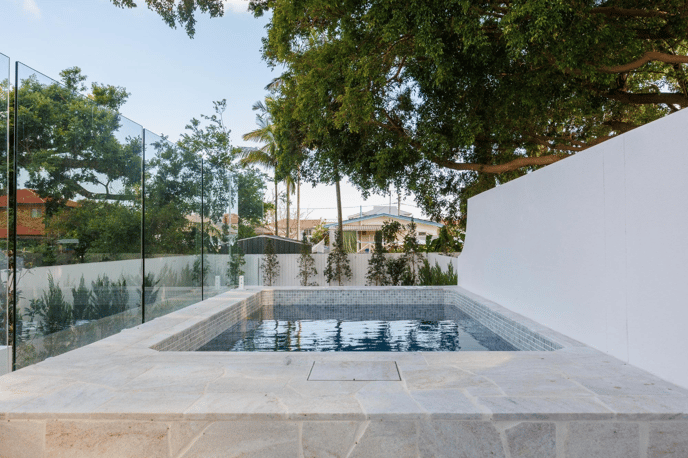
A traditional pool was always going to be a problem in a duplex backyard. The footprint is too big, the lead time is too long, and the cost is hard to justify when you are trying to land a sale at a competitive price.
A precast plunge pool changes the equation. Plungie pools are designed for the compact backyards that dual occupancy creates. The Plungie Studio fits front yards and inner-city courtyards. The Plungie Quad, at 2.2m by 2.2m, is built for the tightest footprints and is often the best fit for compact duplex sites. The Plungie Original works in side returns and small backyards. The Plungie Arena, with its rounded form, works beautifully in tight corners and architecturally distinctive courtyards where a softer shape suits the design language. Each one delivers the visual impact and lifestyle appeal of a full pool without dominating the outdoor area.
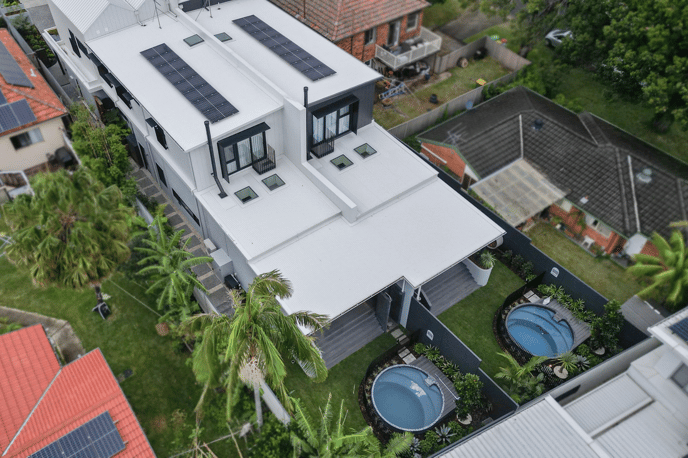
The build timeline is the other big shift. A precast concrete pool is installed in around 14 days, compared to 52 days for a traditional in-ground concrete pool. That is roughly 74% faster, with far fewer trades on site and far less disruption to the build program. For a duplex project where you are trying to keep two dwellings moving in sync to handover, that timeline saving is hard to overstate.
The buyer-side numbers stack up, too. A well-designed pool can add meaningful value to a home, and in compact, premium-finished duplexes, that uplift can show up in faster sales and a stronger price per dwelling. Lower water volume also means lower running costs for the eventual owner, which feeds directly into the energy-efficiency story most modern buyers want to hear.
Plungie pools are made in Australia, NATA accredited, and backed by a 10-year structural warranty. They also carry a 61% lower carbon footprint than traditional pool construction methods, which matters more every year as buyers ask harder questions about how a home was built.
For builders weighing it up, the simplest way to think about a plunge pool in a duplex is as a premium upgrade that buyers can see, feel and value the moment they walk into the backyard. It is one of the few inclusions that pays back across the build program, the sales process and the long-term running costs.


