

There are two ways to build a concrete pool in Australia. You can have one custom-built on your property, poured and cured on-site over several months. Or you can have one manufactured in a factory and craned into your backyard in a single day.
Both are concrete, and both are built to last decades. But the cost, timeline, and what's involved are very different. If you're trying to work out what a concrete pool will set you back, you need to know which type you're comparing.
Here's how the numbers break down.
At a Glance: Custom vs Precast Concrete Pool Costs
|
Custom Concrete |
Precast Concrete |
|
|
Pool shell |
$50,000 - $100,000+ |
$15,000 - $30,000 |
|
Total project cost (installed with fencing, equipment, landscaping) |
$75,000 - $150,000+ |
$37,000 - $57,000+ |
|
Build time |
8 - 16 weeks on-site |
Pool craned in within a day; full project around 2 weeks |
|
Design flexibility |
Fully custom shapes, sizes, and depths |
Fixed sizes; in-ground, above-ground, or semi-recessed |
|
Interior finish |
Pebblecrete, glass bead, or fully tiled |
Factory-applied ecoFinish or raw concrete for on-site tiling |
|
Warranty |
Varies by builder |
Typically 10 year structural warranty |
Those ranges are wide because no two pool projects are the same. What you'll actually pay depends on your site, your location, the size of the pool, and what you want around it.
Let's break that down.
What Affects the Cost of a Custom Concrete Pool?
A custom concrete swimming pool is built entirely on your property. A builder excavates the site, sets up steel reinforcement and formwork, pours or sprays the concrete (using either shotcrete or gunite), then waits for it to cure before applying the interior finish and connecting equipment.
It's a labour-intensive process, and the price reflects that.
Size and shape
A 7m x 3m rectangular pool and a 10m x 4m freeform pool with a spa aren't even in the same pricing conversation. The difference can be $30,000 to $50,000 or more, and it comes down to three things: how much concrete goes in the ground, how much steel holds it together, and how many hours your builder spends on-site.
With custom concrete, every extra metre in length adds roughly $3,000 to $5,000 (but it's not a straight line). Once a pool reaches a certain length (it varies by design and engineering requirements), the steel reinforcement needs to double, and that's where the price jumps sharply rather than gradually. Curved walls, infinity edges, and integrated spas all require custom formwork, which means more labour, more materials, and more time on your property.
With precast, this isn't really a factor. The sizes are fixed, the engineering is already done, and the price is the price. There's no scope creep because there's no scope to creep.
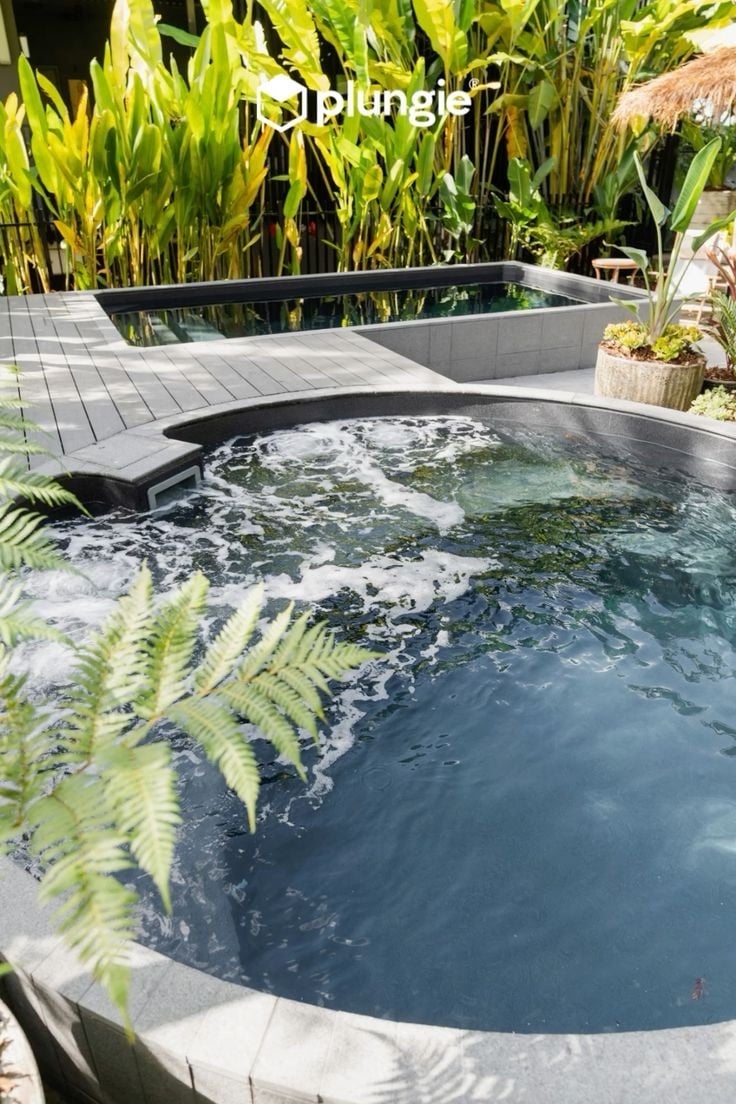
Site conditions
A flat block with good access and stable soil is the cheapest scenario. If your site has any of these, expect the cost to increase:
- Sloped ground: Retaining walls can add $2,000 to $20,000+ to the build.
- Rock: Rock excavation is one of the most common budget surprises, adding $5,000 to $15,000+, depending on depth and volume.
- Tight access: If a standard excavator can't reach the pool area, smaller machinery and hand digging cost more.
- High water table or reactive soil: Additional drainage, engineering, and reinforcement may be required.
Interior finish
The finish you choose determines how the water looks and how the pool feels. For custom concrete, the main options are:
- Pebblecrete (standard): Usually included in the base price. Durable, cost-effective, and available in a range of colours.
- Glass bead pebblecrete: Adds $3,500 to $7,000 for a smoother, more refined finish.
- Fully tiled interior: The premium option, adding $20,000 to $30,000+. Tiles offer the most design flexibility but need re-grouting over time.
Equipment
Every swimming pool needs a pump, filter, and sanitiser. A basic setup costs $3,000 to $5,000. Variable speed pumps, smart automation, and wifi-connected chlorination push that to $5,000 to $10,000+.
Pool heating is separate. Heat pumps are the most popular choice in Australia and cost $3,000 to $6,000 for the unit plus installation. If you're in Melbourne, Hobart, or anywhere south, heating is worth budgeting for if you want to swim beyond summer.
What Affects the Cost of a Precast Concrete Pool?
A precast concrete pool is manufactured off-site in a controlled factory environment. The pool shell is poured into a mould, cured, finished, and then delivered to your property and craned into position. The on-site work is mostly limited to excavation (or base preparation for above-ground installs), crane hire, plumbing, backfill, and connecting equipment.
Because so much of the build happens in the factory, the cost structure is different.
Pool size
Precast pools come in fixed sizes, which means pricing is more predictable. You're choosing from a set range rather than pricing a custom design. For example,we offer five models:
- Quad (2.2m x 2.2m): The smallest option, designed for cold plunge and wellness use.
- Arena (3.5m round): A circular design suited to architecturally designed homes.
- Studio (3.6m x 2.2m): Built for compact backyards, courtyards, and side yards.
- Original (4.6m x 2.5m): The most popular size, fitting comfortably in most suburban backyards.
- Max (6m x 3m): The largest monolithic precast concrete pool available, big enough for a family to swim and entertain around.
The pool shell price varies by model and finish. Because dimensions are fixed, you know the cost before you commit. No scope creep, no mid-build surprises.
Site conditions
Site conditions still matter for precast, but the impact is usually smaller. You're not excavating as deep or as wide, and you're not pouring concrete on-site, so the build is less sensitive to weather, soil type, and access issues.
That said, crane access is the one area where precast costs can escalate. If the crane truck can position the pool directly from the street, that's the standard scenario. If the pool needs to be lifted over a house or there's limited street access, a larger crane may be needed, adding $3,000 to $10,000 to the project.
Interior finish
Most precast concrete pools come with the interior finish already applied in the factory. We use ecoFinish, a high-performance coating available in six colours, included as standard on most models. If you prefer tiles, you can order the pool shell with a raw concrete interior and have it tiled on-site after installation.
Equipment
The same equipment options apply to both custom and precast pools: pumps, filters, chlorinators, heating, and lighting. Precast pool suppliers often offer equipment packages at set prices, which simplifies budgeting. For example, we offer three tiers: a Base package to get swimming, an ECO package with a variable speed pump, and a Smart ECO package with wifi connectivity and automated chlorination.
The Costs That Apply to Both
Whether you go custom or precast, there are project costs that sit outside the pool shell itself. These often catch people off guard because they're not always included in the initial quote.
Fencing
Pool fencing is mandatory across Australia. It's almost never included in a pool builder's base price, regardless of pool type.
- Aluminium fencing: From around $180 per linear metre.
- Frameless glass fencing: From around $350 per linear metre.
Council approval
Building approval is required in every state and territory for any pool or spa with a depth of 300mm or more. Costs vary by council, but budget $200 to $500 for fees. Precast pool suppliers like Plungie provide pre-engineered specifications and preliminary engineering drawings, which can simplify the approval process. Custom builds require a structural engineer to design the pool for your specific site.
Landscaping and surrounds
The area around the pool is often where a significant portion of the budget goes. Plan for:
- Paving or decking: $10,000 to $25,000+, depending on materials and area.
- Electrical work: $1,500 to $3,000+ for a licensed electrician to connect pool equipment.
- Lighting: Pool lights are typically standard, but landscape lighting is extra.
Ongoing Costs: What to Budget Each Year
The upfront cost is one thing. Here's what pool ownership actually costs year to year:
- Chemicals and water treatment: $500 to $1,200 per year.
- Electricity (pump, filter, heating): $800 to $2,000 per year, depending on how often you heat the pool.
- Cleaning and maintenance: $1,000 to $2,000 per year with a professional service, less if you do it yourself.
- Resurfacing (custom concrete only): Every 10 to 15 years, costing $5,000 to $15,000 depending on the finish.
Smaller pools, including plunge pools, cost less to run across the board because there's less water to heat, treat, and filter.
So Which Is Right for You?
Custom concrete makes sense if you want a completely bespoke shape or size, need a pool longer than 6m, want an integrated spa or water features, or have a specific design vision that only a fully custom build can deliver. You'll pay more and wait longer, but you get total freedom.
Precast concrete makes sense if you want the durability and look of a concrete pool at a lower total cost, you value a faster and more predictable build process, or your backyard suits one of the available sizes. You give up custom shapes, but you gain certainty on price, timeline, and quality.
It depends on your budget, your site, and what matters most to you.
Frequently Asked Questions
How much does a concrete pool cost in Australia?
A custom concrete pool typically costs $50,000 to $100,000+ for the shell and basic installation, with total project costs (including fencing, landscaping, and equipment) often landing between $75,000 and $150,000+. Precast concrete pools have a lower total project cost, typically $35,000 to $57,000 fully installed.
Is a concrete pool more expensive than fibreglass?
Custom concrete is more expensive upfront and takes longer to build. Fibreglass pools start from around $25,000 to $50,000 installed, but are limited to pre-set moulds and typically last 25 to 30 years compared to 50+ for concrete. Precast concrete pools are competitive with fibreglass on price while offering the longevity and aesthetic of concrete.
How long does it take to build a concrete pool?
Custom concrete pools take 8 to 16 weeks on-site. Precast concrete pools are manufactured off-site and craned into position in a single day, with the full installation typically completed in around two weeks.
What hidden costs should I budget for?
The most common surprises are rock excavation, retaining walls on sloped sites, upgraded fencing (especially frameless glass), electrical connections, and landscaping. Always ask for an itemised quote and budget an extra 10% to 15% as a contingency.
Is a precast concrete pool as durable as a custom concrete pool?
Yes. Both are made from reinforced concrete and share the same structural properties. Precast pools are manufactured in a controlled factory environment with consistent quality control, which removes some of the variables that come with on-site construction. We, for example, test every pool in a NATA-accredited concrete testing lab and back each one with a 10-year structural and ecoFinish warranty.
Can I install a precast concrete pool above ground?
Yes. Precast concrete pools can be installed in-ground, semi-recessed, or fully above ground, which gives you more flexibility on sites where excavation is difficult or costly. Above-ground installations with timber or stone cladding can also become a design feature in their own right.
Work Out What's Right for Your Budget
If you're weighing up your options,comparing our five pool models is a good place to start for precast pricing. For custom builds, get at least three itemised quotes from local pool builders and make sure each one includes everything beyond the shell: excavation, fencing, equipment, landscaping, and council fees.
The best pool for your home is the one that fits your site, your lifestyle, and your budget, without leaving you with a bill full of surprises.


.jpg?width=325&height=163&length=500&name=plungie-1%20(1).jpg)
.jpg?width=325&height=163&length=500&name=Keats%20St%20-%20Project%20gallery%20page%20(4).jpg)
